

Framing With a Nail Gun – Framing Nail Sizes, Types &; Ring Shank vs Smooth Shank
On this page8 sections
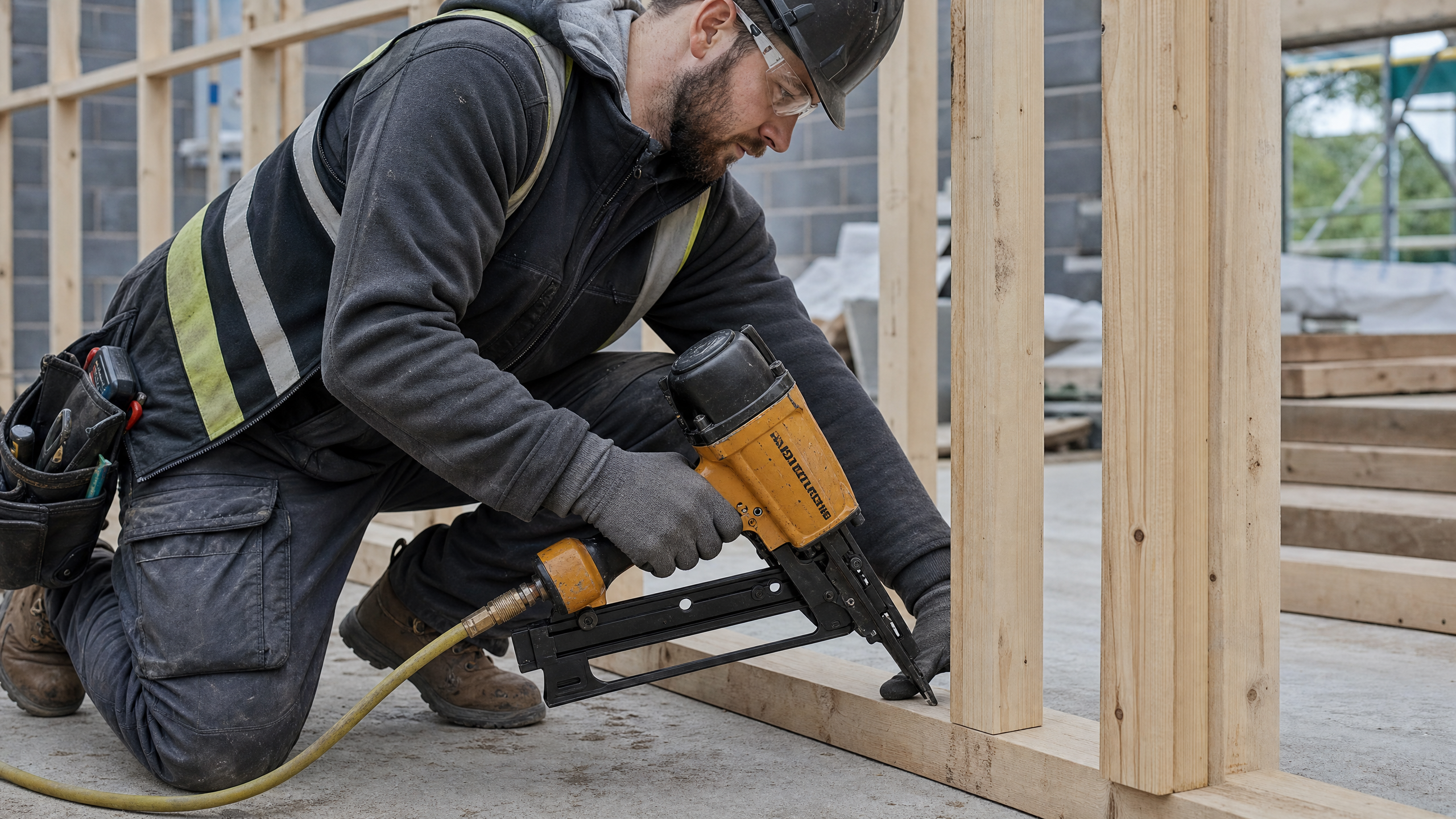
So, what are framing nails? They are heavy steel fasteners designed specifically to feed through high-powered first-fix nail guns. These collated fixings anchor timber frame house extensions securely against severe shear forces and timber movement. Framing with a nail gun requires selecting the correct framing nail sizes, which ensures your fixings comply strictly with local UK building control regulations.
When asking “What size framing nails do I need?” consider timber thickness alongside load conditions. Evaluating ring shank vs smooth shank nails ensures superior holding grip across different types of framing nails.
What are framing nails?
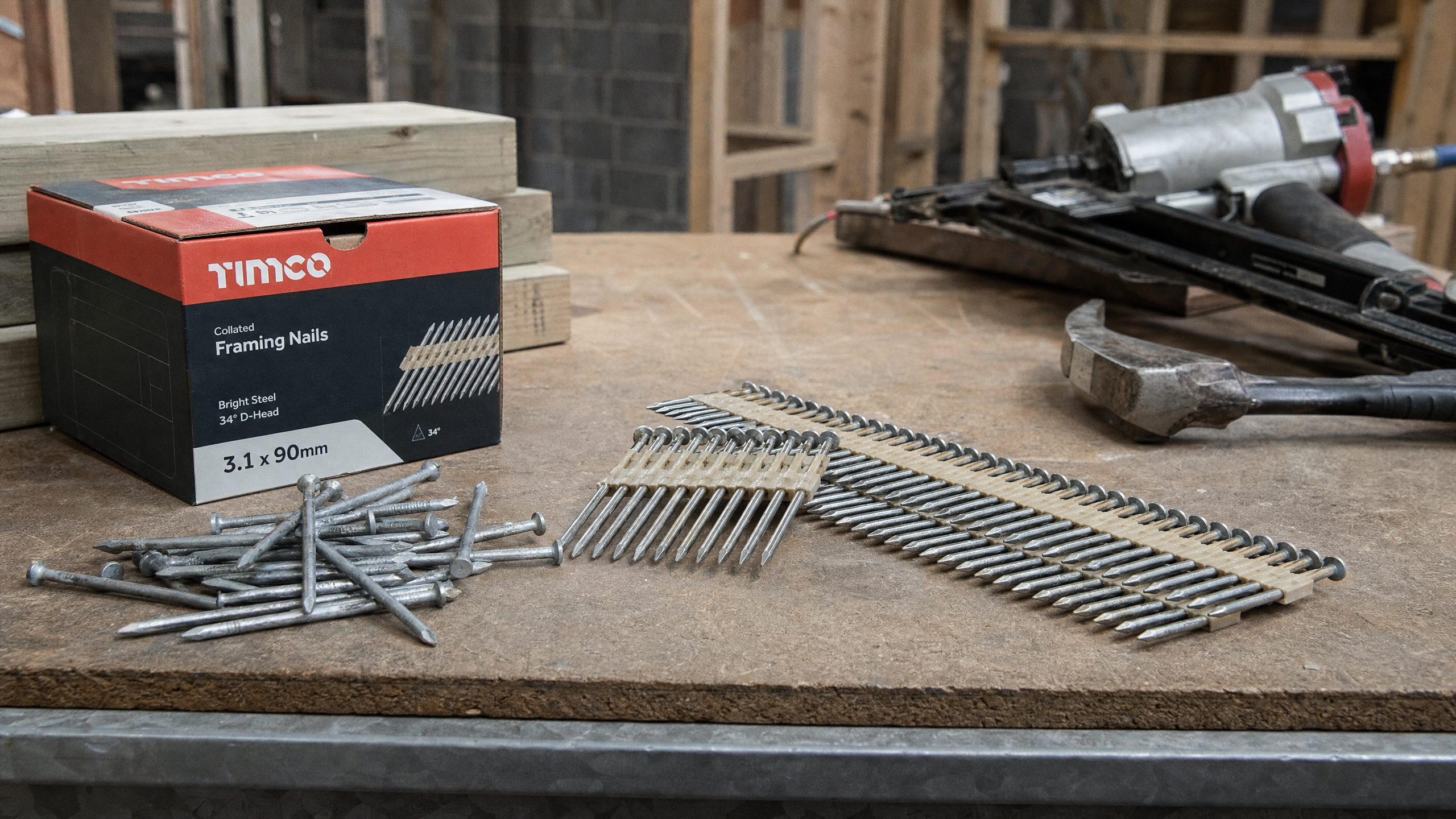
Framing fasteners are high-performance steel nails manufactured to manage heavy structural forces across modern construction builds. Essential for timber frame house building, stud work, and roofing trusses, these heavy-duty fixings drive larger nails to resist severe timber movement. They are supplied as collated nails in angled strips or flat coils for rapid firing from a pneumatic nail gun powered by an air compressor or a cordless tool.
Standard bright steel options handle dry internal timber work. They lack a coating and are prone to corrosion, whereas hot-dipped galvanised coatings resist rust in damp environments. Buy framing nails which are CE marked and conform to Eurocode 5 specifications. This guarantees full compliance with structural building control standards. Modern types of nails come in various shank styles to prevent withdrawal under load.
What size framing nails do I need?
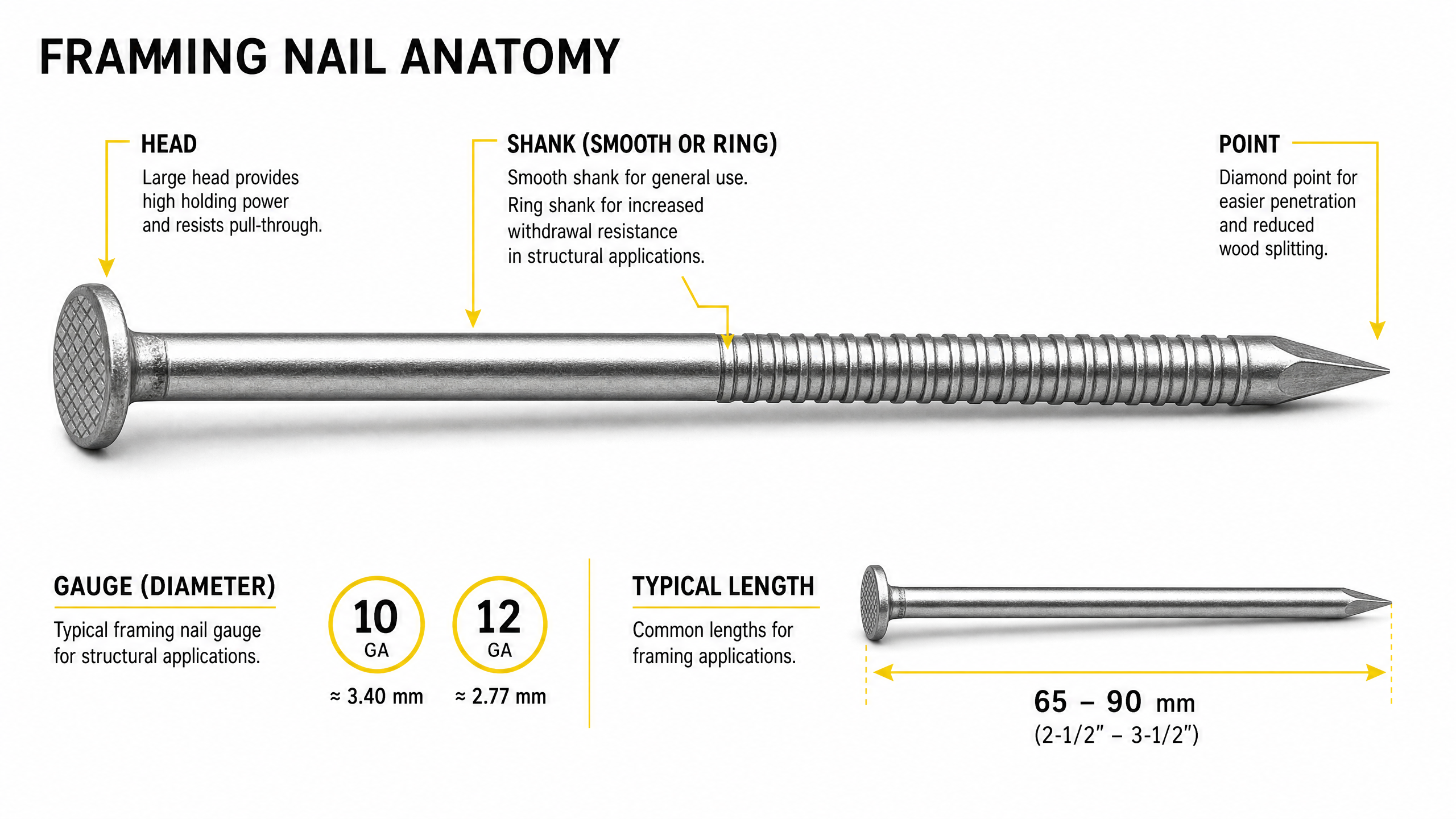
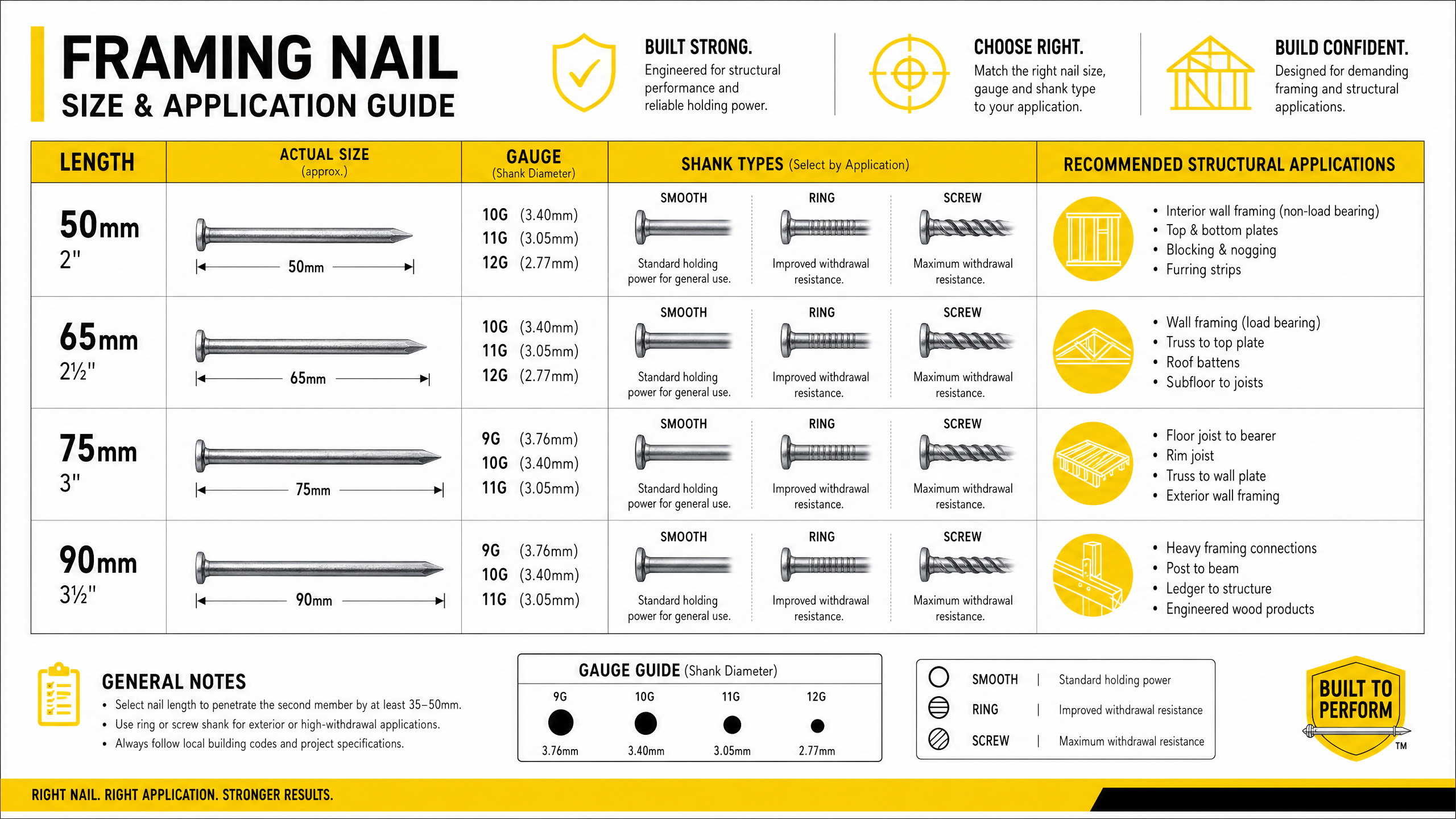
Selecting your nail length depends entirely on timber thickness and structural load requirements. As shown in our reference guide image, fasteners must penetrate the receiving member by at least 35mm to 50mm. Matching shank gauge to your specific job prevents timber splitting and avoids structural failure under stress.
What are the best size nails for framing?
Our technical guide image details the industry-standard framing nail sizes specified across first-fix timber construction. Professional carpenters match these four core lengths to specific site applications when framing with a nail gun:
- 50mm (2″) – specified for non-load-bearing interior timber frames, noggings, and backing strips
- 65mm (2½”) – used for main wall studs, subfloors, and roof battens
- 75mm (3″) – secures structural floor joists, wall plates, and exterior framing joints
- 90mm (3½”) – required for heavy-duty post-to-beam connections and ledger structures
As shown in the application chart, shank diameters range from 2.77mm (12G) up to 3.76mm (9G). Smooth shanks offer standard holding power, whereas ring shanks provide maximum grip. Using electro-galvanised coatings on fixings like bulldog nails prevents corrosion on roof battens and external timbers, making them ideal for heavy structural builds.
Types of framing nails
Selecting the proper nail specification depends entirely on structural loading and site weather conditions. Consider buying any of the following types of framing nails:
- Clipped head nails – compact D-head designs allow high-density strip packing, reducing box quantities needed on site
- Full round head – full head nails feature full-disc heads to offer more holding power and prevent pull-through in heavy structural joints, complying fully with structural regulations
- Hot-dip galvanised – heavy zinc plating forms an essential barrier offering weather protection to conform with outdoor timber building standards and protect structural timber against severe weather moisture
- Paper-collated – clean-shearing paper collation protects operator eyes and leaves no plastic waste underfoot
- Plastic-collated – water-resistant plastic strips prevent collation breakdown when working in wet outdoor conditions
- Ring shank – deep annular rings lock into timber grain, offering exceptional withdrawal strength under load
- Screw shank / Spiral – threaded shanks drive like screws, locking structural timber elements firmly together over time
- Wire collated – heavy-duty wire collation supports bulk coil magazines in coil nailers, maximising efficiency across large roof structures
Matching fastener types to specific applications avoids structural movement in timber frame house building.
Ring shank vs smooth shank nails
Evaluating these nail types helps tradespeople choose the ideal fixing for every timber job:
| # | Feature | Ring Shank | Smooth Shank |
| 1. | Driving resistance | Requires more drive power from modern cordless nail guns | Drives rapidly by hand or tool while placing less stress on driver blades |
| 2. | Holding power | Annular ridges bite into wood fibres for maximum grip | Relies purely on surface friction against the surrounding timber |
| 3. | Material cost | Slightly higher unit cost due to shank ring machining | Cheaper unit price for high-volume structural timber framing |
| 4. | Primary uses | Ideal for exterior decking, timber cladding, and roofing | Ideal for internal partitions, stud framing, and temporary bracing |
| 5. | Shear strength | High shear performance under heavy lateral structural loads | Excellent shear strength across standard timber framing assemblies |
| 6. | Structural fit | Essential where timber expansion and contraction are critical | Typically specified for standard dry indoor structural framing work |
| 7. | Surface profile | Features sharp annular rings machined along the shank length | Features a completely smooth, unthreaded cylindrical steel surface |
| 8. | Withdrawal force | High withdrawal resistance prevents nail popping over time | Lower withdrawal force, making timber separation easier if required |
Framing nails vs finish nails
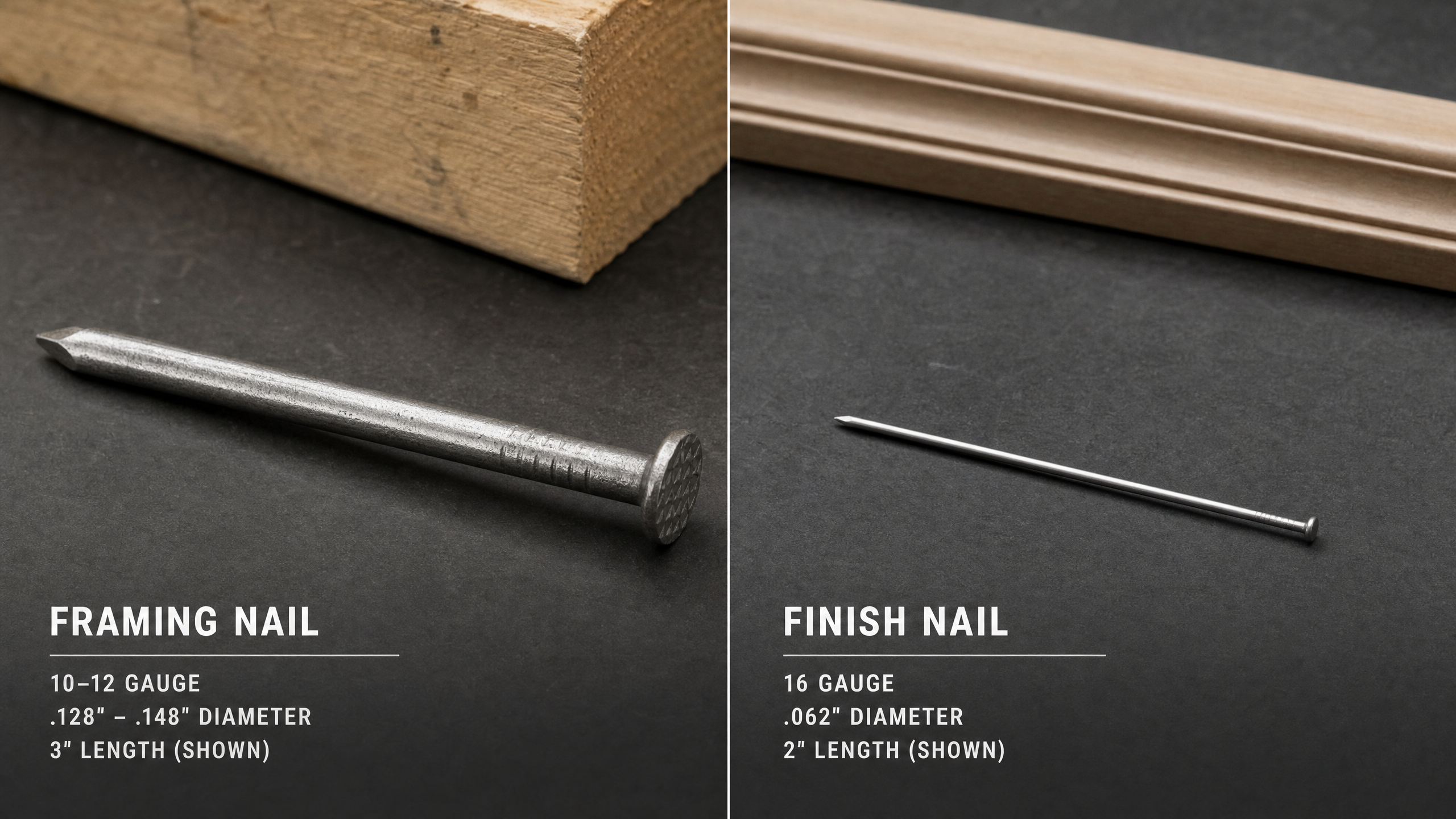
Framing nails differ from finishing nails in strength and size, while finish nails have small heads for concealment. Consider these and other features below:
| # | Feature | Framing Nails | Finish Nails |
| 1. | Collation style | Paper, plastic, or wire strips holding sturdy stick nails | Fine adhesive tape strips holding thin second-fix finishing brads |
| 2. | Head profile | Full round or clipped heads designed for high pull-through resistance | Small, subtle brad heads designed to countersink cleanly into timber |
| 3. | Material surface | Uncoated bright steel or heavy zinc plating for outdoor durability | Fine bright steel or thin electro-galvanised coatings for dry interiors |
| 4. | Primary purpose | Heavy structural timber assembly, load-bearing joints, and framing | Delicate second-fix joinery, decorative trim, and fine moulding work |
| 5. | Shear capacity | High structural load capacity designed to resist intense shear forces | Low shear capacity unsuitable for load-bearing timber structural frames |
| 6. | Site tasks | Essential when putting together wall studs, joists, and shuttering | Perfect for fitting door frames, architraves, window linings, skirting boards, and soffits |
| 7. | Tool type | Fired through heavy-duty first fix pneumatic or cordless battery-powered nail guns (powered by battery cell technology or gas) | Fired through second-fix finish nail guns and precision brad nail guns |
| 8. | Wire gauge | Heavy wire gauges ranging from 28mm up to 38mm diameter | Thin wire gauges ranging from 15G down to 18G pins |
Applications for framing nailers
Choosing first fix nailers speeds up heavy structural assembly across these primary timber construction applications:
- Decking frame construction – fastens structural joists securely when putting together heavy ground timber frameworks for outdoor decking
- Garden building framing – assembles heavy timber wall studs and roof battens for modern outbuildings and timber garden structures
- Roof truss assembly – anchors structural timber trusses securely to top plates, resisting heavy wind uplift and roof loads
- Shed frame construction – builds rigid timber framework, floor supports, and roof rafters for durable outdoor storage sheds
- Site hoarding assembly – connects structural timber posts and outer plywood sheets to construct rigid protective site perimeter fencing
- Structural floor joists – secures structural floor joists to solid masonry hangers or solid timber rim boards safely
- Timber partition framing – drive nails into internal timber studs to erect non-load-bearing room partitions quickly
- Timber stud walls – erects heavy structural studwork frames that comply fully with local UK building control regulations
- Wall frame construction – joins timber studs, noggings, and lintels together to build rigid structural exterior wall panels
- Wooden pallet manufacture – assembles heavy timber shipping crates and heavy pallets rapidly using high-power production tools
Contact us
If you are looking to buy the highest quality framing nails, we stock the best brands here on the Betco Fasteners website. Watch for performance issues and avoid jams when you pick from specially designed fasteners, which are compatible with most brands.
Contact us in the following ways to discuss framing with a nail gun:
- Phone – 0121 552 8400
- Emails – send to sales@betcofasteners.com
- Contact us – through our contact form here