What are flooring nails?
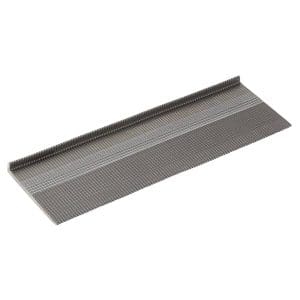
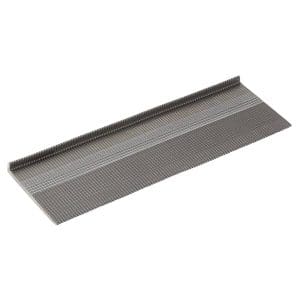
These are collated nails used to secure the wooden floorboards to the subfloor. The gauge will typically be between 16-gauge and 18-gauge and is matched to the profile of the wooden flooring being nailed. Important requirements of these nails are discreteness, powerful grip and moisture resistance. Standard round shank nails just will not do. Flooring cleat nails or coil nails are specifically designed for heavy-duty flooring projects.
The innovative rectangular cross-section and barbed-edge design slice through the wooden fibres without wedging them apart. This has the all-important quality of dramatically reducing the risk of splitting floorboard tongues during installation.
Typical flooring-type applications
Check our technical trade list below to understand and match your specific timber boarding case to the correct fixing profile:
- Fastening decorative perimeter scotia – requires care to complete your second fix job cleanly without causing any unsightly surface timber splits
- Fixing plywood subfloor overlays – provides a flat surface layer before you use any wood flooring nails with heavy pneumatic tools
- Fixing room skirting boards – with a battery-powered finishing tool ensures a clean profile without dragging an air hose around
- Installing chipboard flooring decks – is very easy when using high-capacity nail guns to speed up installation time on various works
- Renovating traditional pine floor planks – requires deep mechanical anchoring to perform neat structural repairs without wasting valuable company money on-site
- Secret-nailing solid hardwood planks – with high-quality hardwood flooring nails provides an affordable way to prevent timber boards from squeaking
- Securing acoustic subfloor underlays – helps deaden walking sound impact across modern domestic installations, depending on the overall layout size requirements
- Securing engineered wood flooring boards – requires a stable nailer to prevent damage and keep multi-ply planks locked down flat
Perimeter trim guidelines
Do not use flooring nails on thin decorative profiles around the room. Thinner 18G brad nails and 21G mini brad nails are ideal for small fitting jobs like fixing skirting board nails or scotia/quadrant mouldings. These fine pins prevent splitting wood on delicate trim but lack the shear strength for main hardwood flooring nail tasks.
Wood flooring nails available from Betco Fasteners
Place an order to buy cleat nails in a 1,000-nail box or coil nails in boxes of 10,000 to 10,500 for use with many compatible nail guns using your trade account.
Flooring cleat nails
These are specialised nails for tongue and groove & engineered wood flooring. Use these to securely fix boards and remove the potential for gradual lifting, moving and squeaking. There are two main types of flooring cleat nails, which are L-shaped and T-shaped.
Here at Betco, choose from two L-shaped cleat nail product options:
Our flooring cleat nails are compatible with the following flooring nailers available online from us:
- Bostitch MFN-201-E Manual Hardwood Flooring Nailer Kit (38-50mm)
Flooring coil nails
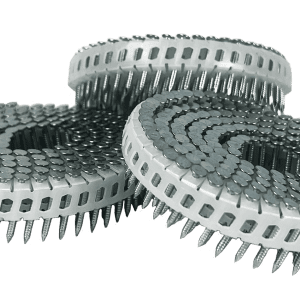
The alternative to cleat is flooring coil nails. The difference here is that the nails are wound into a coil (a circular magazine). Time-efficient from a loading perspective, these ideally suit larger projects and eliminate the need for frequent nailer reloading.
Choose from three main ring shank nails for flooring:
Our flooring coil nails are compatible with the following flooring nail guns, which you can buy online from us:
- Betco CN45 Flooring Coil Nailer (19-25mm)
Cleat nails vs coil nails features
Compare these structural fixing options to find the perfect match for your next flooring contract.
| # |
Feature |
Cleat nails |
Coil nails |
| 1. |
Collation style |
Hardwood flooring nail layouts |
Flexible high-yield wire coils |
| 2. |
Fixing method |
Hidden tongue and groove slots along the joint line |
Surface driving straight through the face |
| 3. |
Insertion angle |
Exact forty-five-degree tilt with total precision |
Straight ninety-degree downward paths |
| 4. |
Main benefit |
Stops wood squeaks completely |
Maximum reloading installation speed |
| 5. |
Primary application |
Hardwood flooring nail layouts |
Subfloor boards and ply overlays |
| 6. |
Tool type |
Dedicated floor nailer |
High-capacity drum nail guns |
| 7. |
Shank profile |
Heavy barbed steel sides |
Ribbed ring shank bodies |
| 8. |
Site environment |
Premium domestic room spaces |
Large commercial apartment block floors |
Other hardwood flooring nails
These fine-gauge nails (sometimes called pins) are perfect and highly suitable for fixing perimeter scotia, quadrant mouldings, and decorative trim profiles. You can use these light options inside air and electric nail guns to finish room borders cleanly.
The following nails are recommended for use with the Maestri ME30 Electric 18G Flooring Nailer (15-30mm):
The following nails are recommended for use with the Spotnails SE30/08 Professional Electric 21G Flooring Pinner (15-30mm):
Flooring staples
As an alternative to flooring nails, you might want to consider flooring staples, such as the heavy-duty Maestri 4000 flooring staples (available in 16mm and 20mm sizes).
Our flooring staples are compatible with the Maestri MC4000 Cordless/Battery Flooring Staple Gun (16-20mm), Maestri MC606 Cordless Flooring Staple/Nail Gun (15-25mm) and Maestri ME606 Electric Flooring Staple/Nail Gun (15-25mm). Choose from:
- Maestri 4000 Flooring Staples 16mm (10,000 Per Box)
- Maestri 4000 Flooring Staples 20mm (10,000 Per Box)
Which materials are typically used to manufacture nails for flooring?
If you are fixing basic plywood subflooring or chipboard decks using coil nails, galvanised or bright carbon steel is the standard trade choice. If you are secret-nailing premium oak or exotic hardwood floorboards using cleat nails, hardened galvanised steel is typically used.
Why does choosing the correct nails prevent timber splits and surface damage in flooring?
An important aspect of preventing timber splits is choosing the correct fastener gauge. Using too thick a gauge can cause structural cracking with the interlocking tongue joint. The aim of flooring nails must be to securely fix the flooring invisibly without causing a split to the often delicate edges of timber.
Flooring is often high cost, so it is important to get this right. Whichever nailer you use, it is important that the flooring nail easily passes through the subfloor. The implications of incorrect nailing are that it will ruin perfectly fine floorboards and be costly and time-consuming to fix.
Contact information
Why not speak to us to explore hardwood flooring nails and our nail guns or staple guns technology? We can advise on the best nailer for you, including power source, features, portability, etc., as well as our VAT policy. Please note our flooring nails or staples are not suitable for use with laminate flooring.
Contact us in these ways to access our UK team:
- By phone – 0121 552 8400
- By email – sales@betcofasteners.com
- Contact us form – click our Contact Us page link on the website