The first fix stage
This refers to all the structural, framing, and infrastructure work completed in a building before internal walls are plastered or sealed. Think of it as building the skeleton and nervous system of the property. It establishes everything that will eventually be hidden behind plasterboard, under floorboards, or inside ceiling voids. This includes carpentry & structural, electrical and plumbing & mechanical tasks. Many of these need first fix nails throughout various stages of the work.
What are first fix nails?
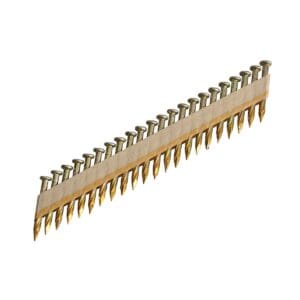
These are heavy-duty collated nails designed for structural framing and load-bearing timber assembly on site. Driven by a pneumatic nailer or gas nail gun, these heavy framing nails secure floor joists, roof trusses, timber frames, and garden fencing. They come in various shank types, including smooth shank and ring shank nails, to suit different applications.
Supplied in a collated strip, they ensure reliable performance while saving time on busy construction jobs. Select your required pack size and add to basket on our website for fast site delivery.
What first fix nail gun nails does Betco Fasteners sell?
Understand our product selection by reading the details below. Each item below is ready for delivery UK-wide:
A) By collation types & angles
Selecting the correct collation angle ensures your nail gun operates cleanly without jamming on site.
- 21° & 28° strip nails – first fix collated nails are thicker than second fix nails, requiring compatible framing tools to fire properly. These plastic or wire-collated strips accept full round head nails, delivering robust structural holding power across heavy timber frames and joist subframes
- 22° plastic collated strip nails – plastic collation holds full round head 1st fix nails firmly in place during rapid firing. Safety glasses are essential when using nail guns to protect your eyes from shattering plastic fragments on site
- 34° paper collated framing nails – paper collated first fix nails leave no plastic debris across the job site after driving. First fix nails must penetrate deeply into the material for better holding strength in structural timber
B) 1st fix nails by finish & material options
First fix nails are manufactured from high-grade steel for durability, but there are a range of options:
- Bright steel – uncoated first fix nails suit internal framing where timber stays completely dry on site
- Galvanised steel – galvanised nails should be used for outdoor applications to prevent rust and maintain joint strength across different types of exterior 1st fix nail jobs
- Stainless steel – premium-grade stainless first fix nail gun nails protect cladding and oak framing against severe chemical corrosion and harsh changing weather conditions
C) By sizes & profiles
Selecting the right length and wire thickness ensures your structural timber connections hold securely.
Lengths
These range from 50mm up to 90mm. Longer 1st fix nails provide essential depth for heavy structural framing work. First fix nails must penetrate deeply into the material for better holding power across floor joists, wall studs, and roof trusses.
Gauge/Diameters
These range from 2.8mm to 3.3mm. First fix collated nails are thicker than second fix nails to carry heavy load weights. Thicker first fix nail gun nails ensure joint rigidity, though first fix nails leave larger impressions compared to second fix nails.
Shank profiles
Selecting the correct shank profile ensures your structural timber connections hold firm under load:
- Plain shank – a standard penetration force; these smooth first fix nails drive smoothly into dense timber, ensuring fast framing production
- Ring shank – annular rings for high pull-out resistance. These 1st fix nails feature distinct ridges that lock permanently into timber fibres
- Screw shank – threaded drive for maximum holding power. These threaded first fix nail gun nails twist during insertion to prevent timber withdrawal
D) Package types
Choose from two main package types:
1) Nail & gas fuel cell packs (Spotnails & Fischer)
Bundled packs contain heavy first fix nails alongside matching fuel cells for gas-actuated framing tools. Regular maintenance ensures safe and efficient nail gun operation on site. These combined packs supply enough gas to drive every nail.
2) Nail-only boxes
Bulk boxes supply 2,200 to 3,300 first fix nail gun nails without fuel cells. Pneumatic nail guns require an air compressor for operation, making these boxes ideal for air tools.
E) Tool compatibility
These nails fit major 1st-fix framing tools on the market, including:
- 34° paper-tape nailers – Paslode IM350, Milwaukee M18 FFN, DeWalt DCN692, Tacwise KDH90V, Spotnails SBFN3490, Bostitch F33PT-E / GF33PT, Senco GT90CH, Makita GN900SE, Rawlplug WW90CH, and Fischer FGW90F.
- 21°/22° strip nailers – Bostitch F21PL-E, Tacwise KSN90V, and other standard 21° plastic-collated framing guns
What are first fix nails with gas packs?
These are bundled consumable sets designed for cordless gas-powered framing nailers (such as Paslode, Tacwise, Senco, or DeWalt gas tools). First fix nails with gas packs combine the heavy-duty nails required for structural carpentry with the fuel cells needed to drive them.
What are the differences between first fix and second fix nails?
For clarity, these are the main differences between the two nail types:
| # |
Feature |
First Fix Nails |
Second Fix Nails |
| 1 |
Structural load status |
Engineered for structural, load-bearing timber work |
Engineered for non-structural interior joinery tasks |
| 2 |
Penetration depth needs |
First fix nails must penetrate deeply into the material for better holding |
Shallow penetration into internal timber linings |
| 3 |
Material impression size |
1st fix nails leave larger impressions compared to second fix nails |
Minimal surface mark requiring light filler work |
| 4 |
Collation material types |
Paper tape, plastic strip, or wire weld collation |
Soft plastic or glue band collation strips |
| 5 |
Outdoor durability options |
Galvanised nails should be used for outdoor applications to prevent rust |
Stainless options used for damp or external trim |
| 6 |
Fastener removal effort |
First fix nails can be difficult to remove once driven into timber |
Easy to punch through or lever out |
| 7 |
Primary trades user |
Structural carpenters, frame builders, and roofers |
Finish carpenters, joiners, and shopfitters |
| 8 |
Structural gauge range |
Thick wire gauges designed for joint shear strength |
Fine wire designed to prevent timber splitting |
Safety tips
Always be safe when driving first fix nails, this is especially true for disabled users:
- Protect hands – gloves improve grip and protect hands during use
- Protect hearing – ear protection keeps your ears clean and is recommended to reduce noise exposure
- Take care – proper handling prevents accidents when using nail guns
Contact Betco Fasteners
Speak to us about your ordering preferences and we can advise about the core functionality of our first fix nailers and which collated nails to choose. We also supply second fix nails, such as brad nails and finish nails.
Contact our customer service team for insights and product advice: