
Pin Nailer vs Brad Nailer: Types of Nailers, Sizes & When to Use Each
On this page9 sections
Every carpenter knows that second fix joinery demands a careful balance between structural grip and clean visual finishes. Choosing between a brad nailer and a finish nailer, or a pin nailer and a brad nailer, changes your entire joint-finishing process. For example, using larger nails on fragile architraves will split the wood grain and leave large, visible nail holes.
Here we examine the core types of nailers to help you select the ideal wire gauge for your specific timber profiles. Our breakdown ensures you always drive nails with the exact depth and holding capability your workshop assemblies require, no matter what nail size you choose.
Common types of nailers for second fix tasks
Choosing the correct tool keeps your commercial second-fix installations secure, clean, and looking highly professional. We stock a wider range of different types of nailers, which can be used as versatile finishing tools.
16-gauge finish nailers
These heavy-duty guns provide critical mechanical anchoring strength for internal timbers. Our 16-gauge finish nailers offer much greater holding power than smaller pinning tools on site. They drive thicker nails that anchor heavy trim firmly against irregular wall surfaces. They are the standard trade choice when installing baseboards or heavy timber linings, giving your joint lines more strength instantly.
However, they leave a slightly larger hole that requires extra work before decorating. We also supply premium 15G angled finish nailers. These angled units provide excellent nose clearance when working inside deep, awkward corner joints on demanding structural tasks.
18-gauge brad nailers
This system offers the perfect daily balance between joint security and clean surface finishes. For everyday visual trim work, 18G brad nailers are incredibly dependable. A brad nailer offers useful mechanical grip without the risk of splitting narrow softwood pieces. The thin head profile means you do not have to worry about large, ugly brad nail holes destroying the timber face.
This is a fantastic option for fixing architraves and lightweight internal door casings. If you oversee highly fragile decorative work, we also supply 21G mini brad nailers. These compact tools are perfect for pinning narrow beadings smoothly to give a clean look.
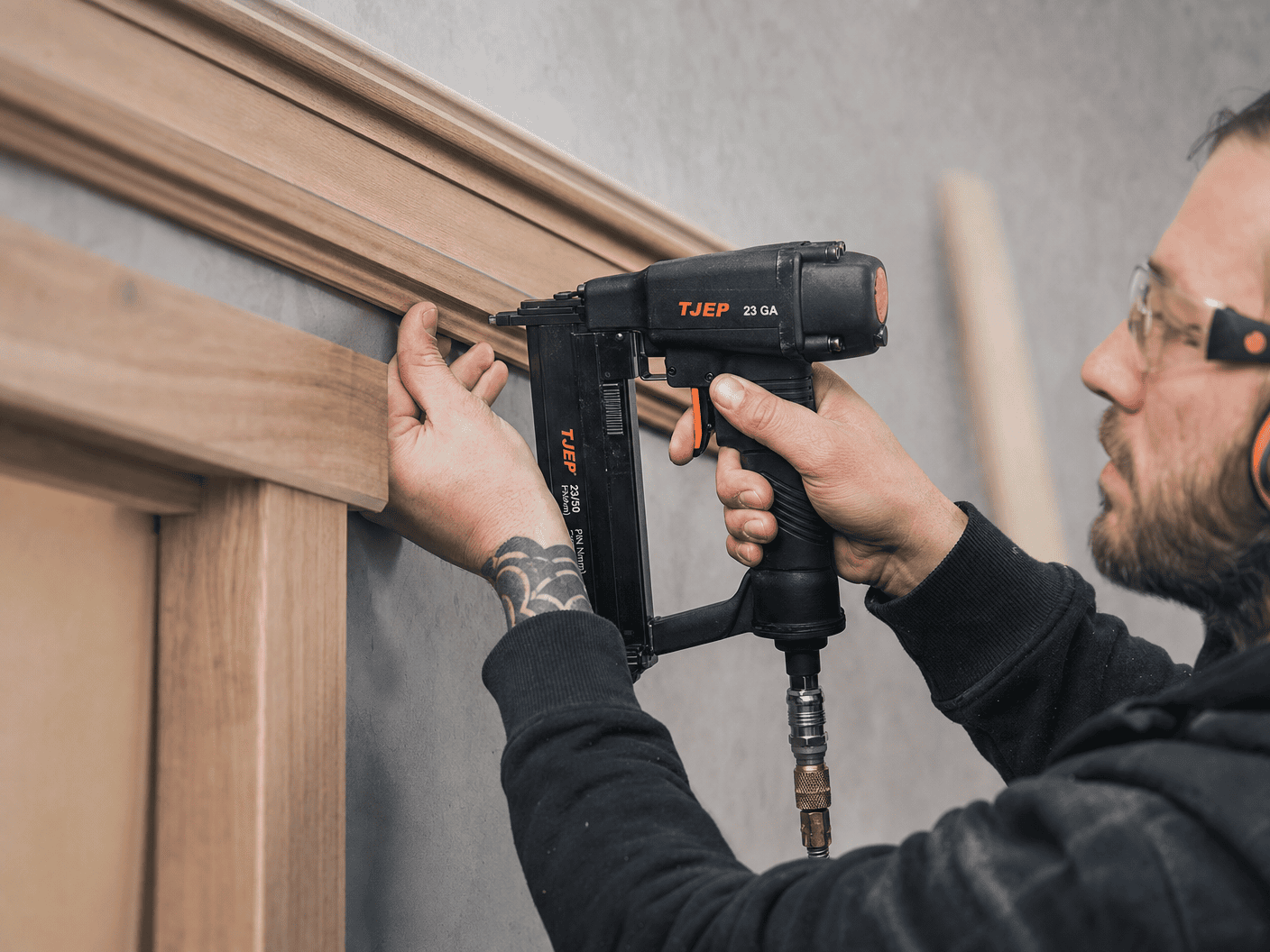
23-gauge pin nailers
These headless pinning guns provide the ultimate invisible finish on high-end joinery installations. When working with ultra-thin timbers, 23-gauge pin nailers offer unparalleled precision. They fire micro headless pins that leave tiny holes, which require virtually zero prep work.
These 23G pin nailers provide the necessary clamping pressure to hold visual pieces steady until your main wood glue cures completely. They are the cleanest option for fine cabinet trims and delicate glazed panel frames.
Understanding nailer sizes for different applications
We analyse below the different pin and brad nailer sizes and consider some popular applications:
- 15G angled finish nailer – complete fine finish work including architrave corner mitres, deep window boards, door casings, external shiplap cladding, heavy door frames, internal timber door linings, ornate finish carpentry carcass joints, heavy stair treads, tongue & groove ceilings, and thick wood porch columns where you need real holding power
- 16G finish nail gun – ideal for cabinet carcass joints, dado rails, exterior fascia boards, internal window reveals, installing baseboards, oak fireplace surrounds, plywood subflooring sheets, solid timber flooring, tongue and groove wall panelling and wooden window frames that demand more strength
- 18G brad nail gun – use these for woodworking projects, including bird boxes, tongue and groove cabinet backing sheets, decorative trim, drawer glides, internal window beads, lightweight panel mouldings, MDF panelling, picture frames, shaker door moulds, and soft wood framing
- 21G mini brad nailer – ideal for small projects including architectural model making, delicate cabinet trim, face frames, glass retaining beads, lightweight trim strips, pet cages, small clock cases, thin plywood backing, toy making and veneered edging profiles to ensure a clean look
- 23 pin nailer – these are perfect for delicate pieces, including antique furniture restoration, delicate carving details, delicate trim pieces, intricate filigree work, jewellery boxes, model railway layouts, picture frame slips, scribed infill strips, temporary holding of glued components and ultra-thin wood laminates
Brad nailer vs finish nailer – A table of comparison features
Below, we break down the main differences between these second-fix tools to protect your timber:
| # | Feature | Brad Nailer | Finish Nailer |
| 1 | Depth regulation | The scrolling wheel offers rapid adjustment of the driver pin travel distance | Precise mechanical thumbwheel ensures highly accurate counter-sinking depth control |
| 2 | Fastener collation | Straight paper or glue collated stick strip formations | Straight or angled collated heavy steel strip formats |
| 3 | Hardwood performance | Thin wire brads can buckle when striking dense timber grains | Drives heavy finish nails cleanly into tough seasoned oak profiles |
| 4 | Interior layout role | Ideal tool for pinning decorative trim and narrow beadings | Workhorse tool for heavy second-fix finishing work and boards |
| 5 | Investment tier | Affordable entry price point for workshop or onsite tool kits | Premium trade tool pricing reflecting heavy mechanical internal build quality |
| 6 | Material pairing limits | Best suited for softwoods, thin MDF, and veneered panels | Engineered specifically for heavy timbers, thick boards, and plywood carcasses |
| 7 | Operational freedom | Compact size gives ultimate mobile flexibility on step ladders | Cordless options eliminate the need for trailing air compressor lines |
| 8 | Pull-out resistance | Low-friction grip relying mainly on wire shaft texturing | Exceptional resistance due to substantial mechanical head profile designs |
| 9 | Single fix capacity | Best used if you intend to use a brad nailer for trim | Designed to provide total standalone mechanical structural joint connections |
| 10 | Target trade audience | Interior shopfitters, cabinet makers, and bench joiners in workshops | General building contractors, site carpenters, and professional second-fix tradespeople |
Pin nailer vs Brad nailer – Which should you choose?
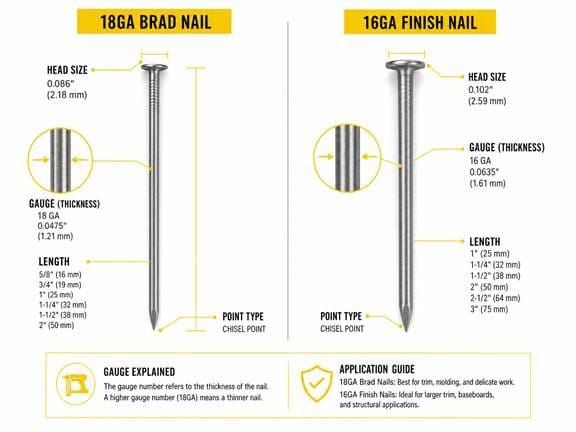
Your final decision between a pin nailer vs brad nailer depends entirely on the thickness of your timber profiles. If you are fitting thicker architraves or panelling, choose an 18-gauge pneumatic nailer. This great tool drives rectangular wire brads that offer reliable mechanical grip across a wide range of second-fix tasks. The head profile ensures a stronger hold, so your components remain locked down firmly without needing additional support.
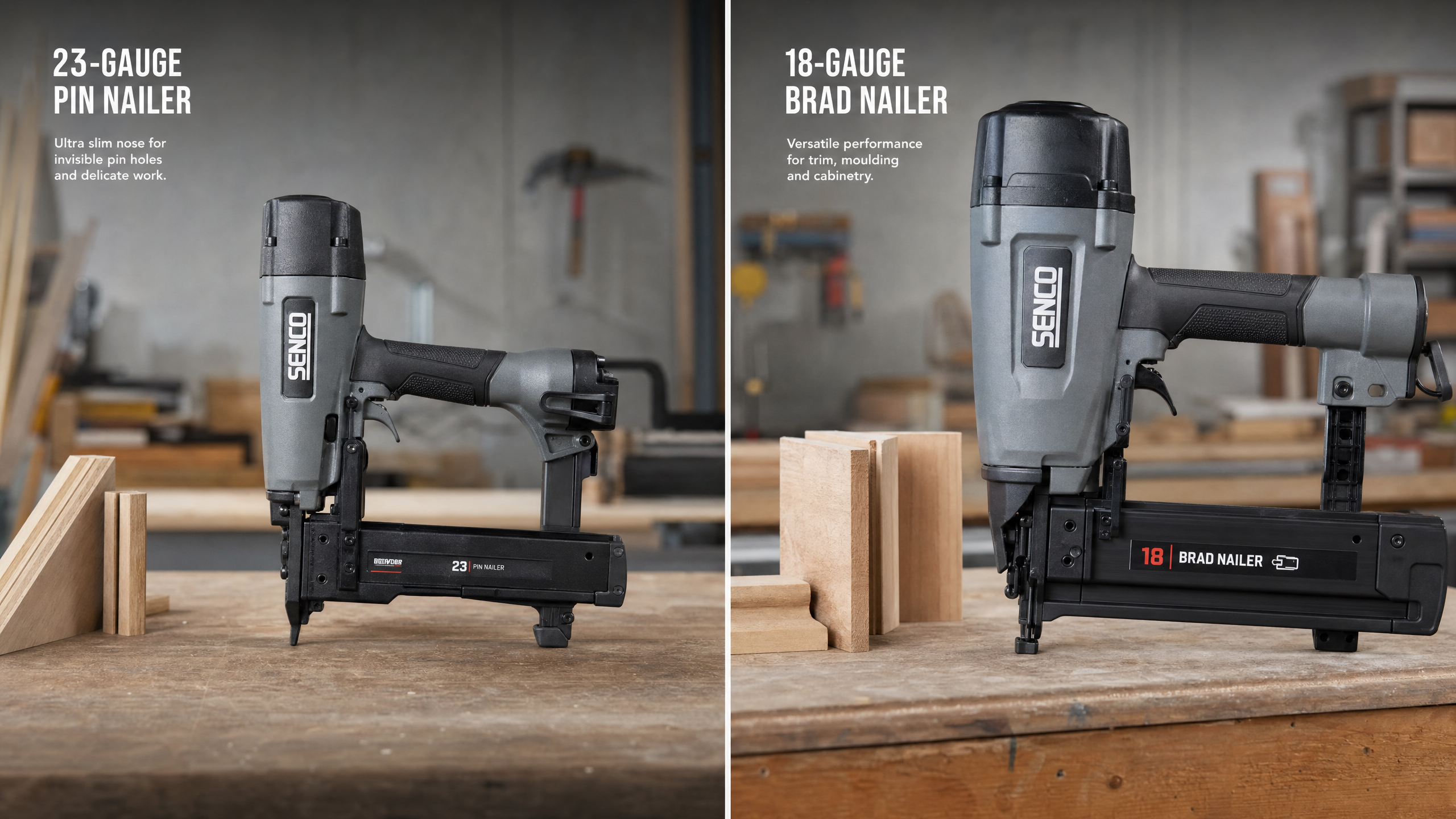
For intricate beadings and ultra-thin visual trims, a 23-gauge pin gun is the correct choice. These compact types of nailers fire ultra-slim headless nails that leave almost microscopic pin nail holes. They function perfectly for holding pieces accurately in position until your primary wood assembly glue dries. They ensure an exceptionally clean finish across premium timber faces and save you valuable decorating time on site.
Final thoughts
Selecting the right tool down at the merchant counter means matching your timber thickness to the correct anchoring grip. When evaluating a pin nailer vs brad nailer, it highlights how vital gauge selection is on a busy commercial site. These key differences in tool chassis design allow you to safely balance structural strength against surface damage. Firing fine, small nails keeps your narrow timber profiles completely free from splitting. Stocking a wider range of nailer sizes keeps your carpentry work efficient, pristine, and highly professional.
Contact us
Choosing the right nailer is an important trade decision. Heavy-gauge nails provide more holding power for structural tasks, whereas delicate decorative pieces need an invisible finish. Different nailer sizes determine whether your timber profiles require filling later.
Contact us for direct advice on all aspects of buying a nailer, including matching the perfect power source (cordless, electric, pneumatic, etc) to your project. Contact us in these ways:
- Calls – 0121 552 8400
- Emails – send to sales@betcofasteners.com
- Contact form – our contact us page allows you to complete this online