Pneumatic vs Cordless Nailers: Nail Gun Types & Air Compressors Explained
On this page23 sections
Choosing a new heavy-duty timber fixing system is a major financial decision for any expanding commercial contracting business. Picking the wrong setup can leave your timber framing crew facing frustrating site delays or excessive physical wrist strain. Modern technological developments mean choosing between pneumatic vs cordless nailers is no longer a straightforward choice.
Your final selection depends heavily on matching your typical daily job size to the right power delivery setup. This straight-talking trade guide breaks down common nail gun types to keep your site operations moving fast.
What are the main types of nail guns by power source?
Different nail gun types suit different tasks on the modern construction site. Choosing the right power source determines your daily working speed. Here are the four main options:
1) Cordless (battery) nail guns
Running on modern lithium battery packs, these units offer total freedom of movement around high scaffolding and roof joists. Cordless nail guns are brilliant at working in tight spaces where you might need only a few nails and dragging heavy workshop equipment is difficult. Having a minimum of two batteries is highly recommended on live jobs. This setup ensures you can quickly swap batteries to keep working whilst the depleted pack charges in the van
2) Electric (corded) nailers
These tools plug straight into 240V mains outlets or a yellow site transformer step-down box. Electric nailers provide continuous firing power all day long without any performance drop. However, they require trailing extension cables that can easily tangle on messy building floors. Managing these heavy power leads across a busy workspace can introduce serious safety hazards and severely limit your overall mobility
3) Manual
This basic mechanical option relies entirely on direct hand pressure and internal spring tension to seat the fastener. These hand nailers are only suitable for very small fixing jobs around the workshop. They save time compared to using a traditional claw hammer for light adjustments. However, they lack the driving force required to sink heavy structural fasteners into dense construction timbers.
4) Pneumatic (air)
These traditional pneumatic nail guns connect directly to an air compressor via a heavy-duty flexible rubber hose. Heavy workshop use demands this setup since it delivers completely consistent power through constant air pressure. The tool body stays lightweight in your hand during extended framing shifts. Mechanical reliability is exceptionally high since there are very few complex electronic components inside the main chassis.
Throughout the remainder of this article, our focus will be on comparing cordless vs pneumatic nailer functionality.
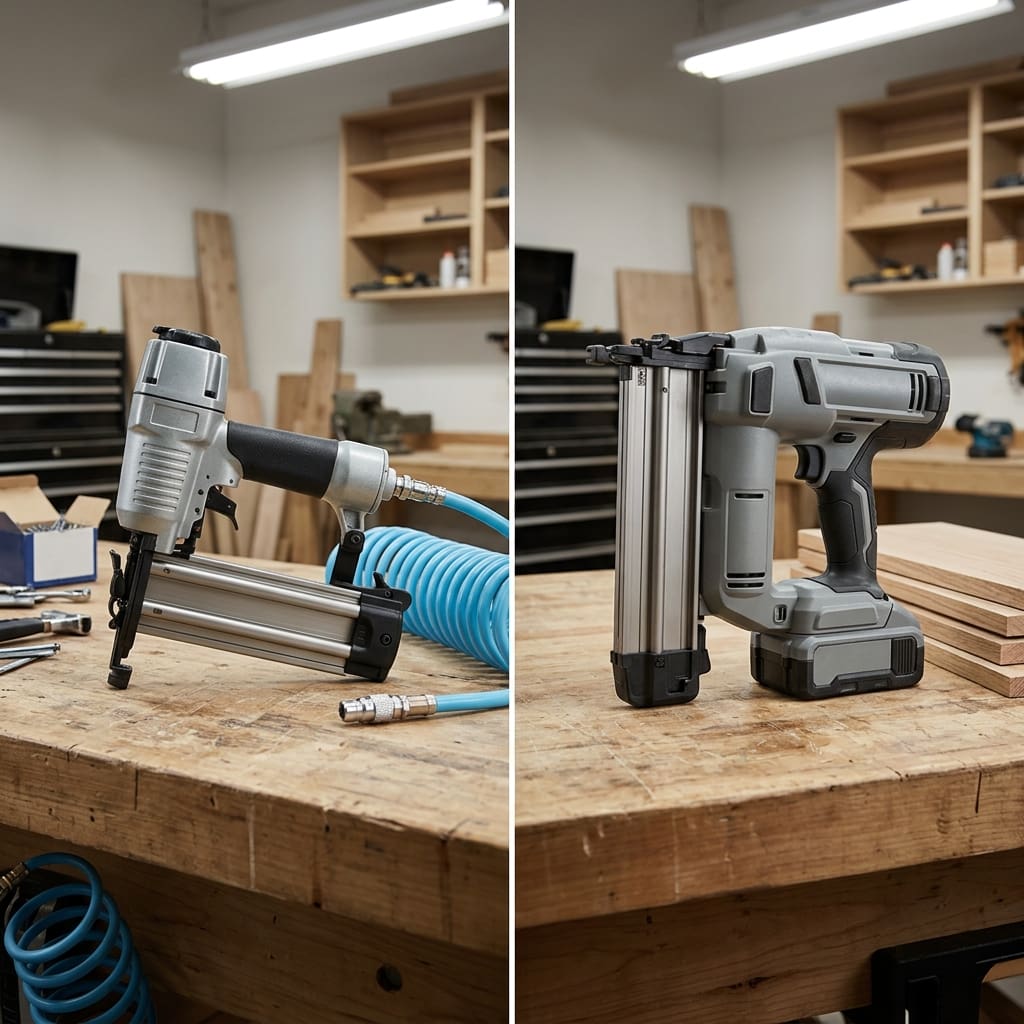
Features – Pneumatic vs cordless nailers
Choosing between pneumatic and cordless nailers successfully requires an in-depth understanding of the typical features for these types of nail guns.
| # | Feature | Pneumatic | Cordless |
| 1. | Cold weather performance | Moisture inside the tool line can freeze up the main valve mechanism | Extremely low temperatures reduce chemical battery efficiency and overall runtime |
| 2. | Exhaust gas emissions | Emits completely clean compressed air from the tool cylinder during the firing cycle | Internal combustion models release noticeable gas fumes that can build up indoors |
| 3. | Firing speed | Rapid, instant cycle times for rapid production. They can drive thousands of nails without downtime | May take a second to fire the first nail as the motor cycles |
| 4. | High-altitude operation | Firing pressure remains stable as the compressor adjusts to the atmospheric density | Altitude changes have zero effect on the internal flywheel or motor operation |
| 5. | Mobility | Limited by the length of the trailing line | Complete freedom to move around the workspace |
| 6. | Noise level | High compressor noise during regular tank refills | Quiet operation with only brief motor sounds |
| 7. | Output consistency | Completely uniform depth control all day long | Power can drop as the charge depletes |
| 8. | Overall weight | Very lightweight and balanced in the hand. Pneumatic nailers typically weigh around 2 pounds | Heavier due to the integrated motor drive. Cordless nailers can weigh up to 7 pounds |
| 9. | Physical tool profile | Slim cylinder nose design allows easy visibility into narrow corners and tight joints | Bulkier motor housing can block your direct line of sight in awkward gaps |
| 10. | Platform compatibility | Universal air coupling fits any standard hose setup regardless of the tool brand | Batteries are strictly locked to the specific manufacturer charger system |
| 11. | Power source | Compressed air via a workshop or site compressor | Removable rechargeable lithium-ion battery packs for extended battery life |
| 12. | Proper maintenance | Requires regular oiling to protect internal seals and keep in optimal condition | Cordless nailers require clean magazines and dust removal |
| 13. | Running cost | Low long-term expense with simple mechanical parts | Higher cost due to replacement battery units |
| 14. | Setup time | Longer initial setup to connect the equipment | Instant operation right out of the carry case |
| 15. | Site safety | Air lines can present potential trip hazards | Clear floors with no cables or pipes |
| 16. | Tool lifespan | Excellent durability over extended periods with very few moving parts | Shorter lifespan due to complex internal electronics |
| 17. | Upfront cost | Lower initial tool price but requires a compressor | Higher initial outlay for standalone kits, especially on small jobs |
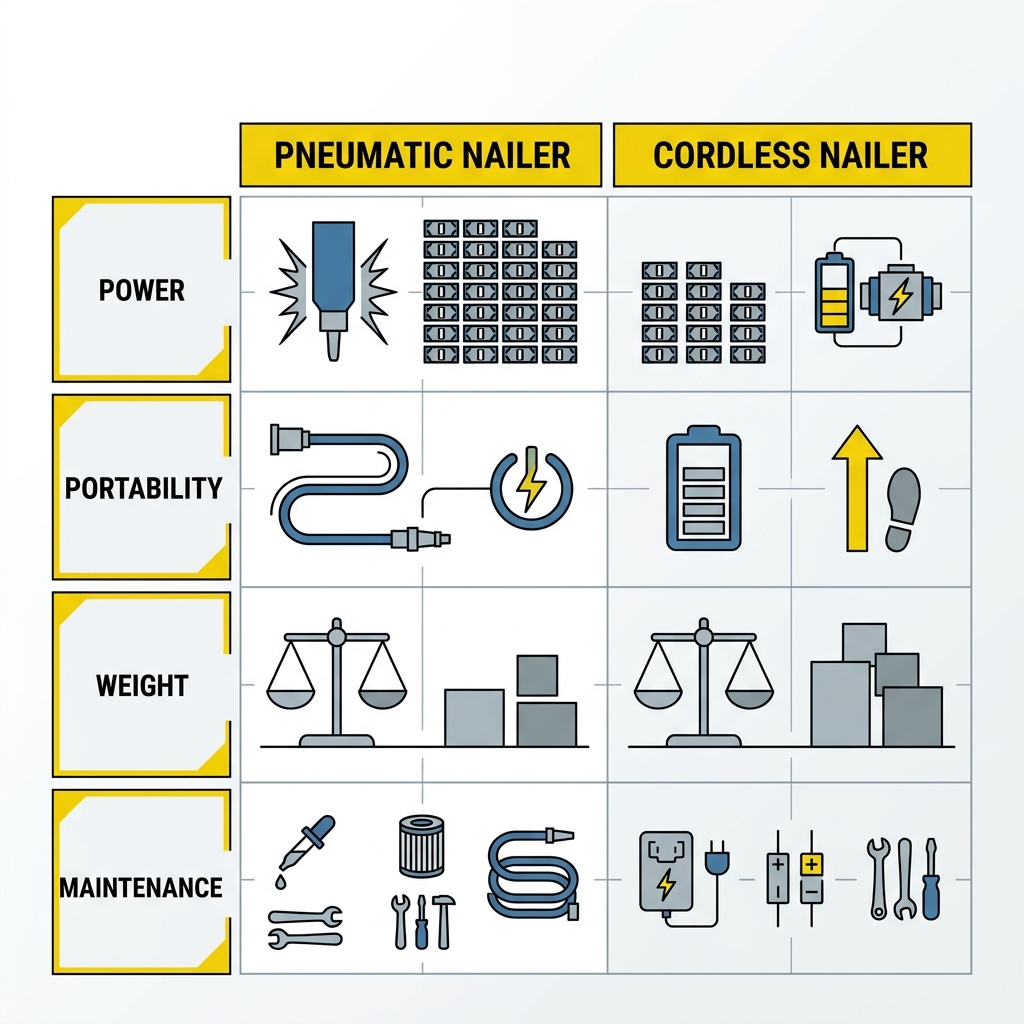
Understanding nail gun types by fastener size
Your daily choice of fixing gauge determines whether a cordless vs pneumatic nailer configuration is the most profitable choice for your workshop:
1) Pin nailers
These are perfect for pinning delicate 23G grain mouldings without splitting the timber. Battery options for pin nailers are rare because the heavy chassis limits visibility in tight spots.
2) Brad nailers
The primary tool for securing 18G internal shop fittings and trim work. Using modern cordless brad nail guns eliminates layout preparation times completely when completing quick domestic callouts.
3) Finish nailers
Built to secure heavy 16G door linings. Traditional air-driven finish nailers are lightweight, while cordless units save valuable time during high-level installation work.
4) Flooring nailers
These are heavy-duty nailers, which are engineered to take direct blows from a rubber mallet. Portable battery platforms are completely absent from this flooring nailers category.
5) First fix nailers
Built to drive long structural fasteners into thick structural timber. Cordless first fix nailers offer total freedom on roof trusses where lines pose hazards.
6) Roofing nailers
These are designed to anchor heavy external slate battens using high-capacity coils. Battery alternatives are rare (although we do sell the Spotnails SBFN3490 Cordless 1st Fix Framing Nail Gun (50-90mm)). Cordless is problematic with a fully loaded roofing nailer tool, as it becomes too heavy. A coil nailer is a popular roofing option.
7) Framing nailers
Are the primary workhorse for heavy timber studwork construction. Opting for traditional framing nailers keeps your hand fatigue low during long framing shifts.
Understanding how different nail gun types handle specific fastener gauges prevents expensive tool breakdown delays on live commercial projects.
Cordless vs air nail gun – Comparing mobility vs setup speed
We touched upon mobility and set-up speed in the features table. We discuss this in more depth as these are often important purchasing considerations.
Mobility
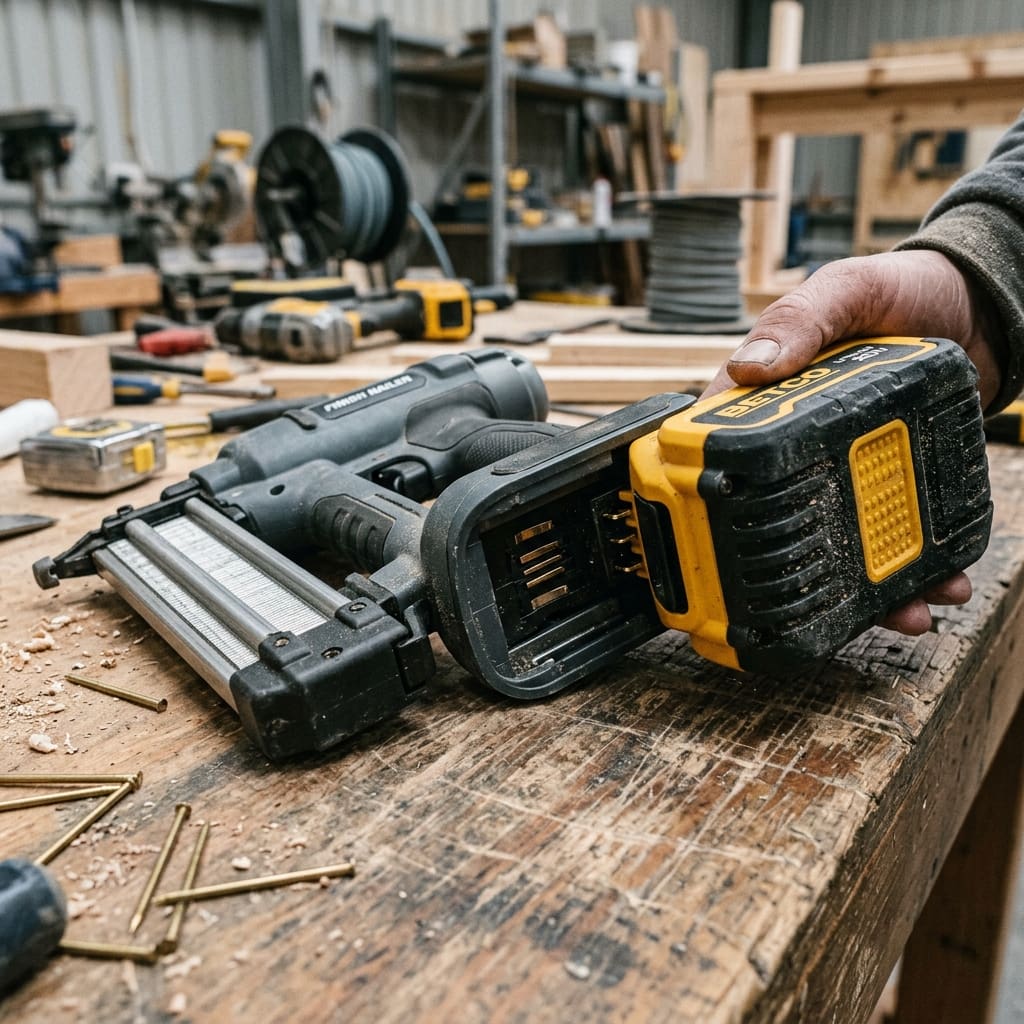
On an active job site, total freedom of movement is a major advantage. Modern battery nailers let you move across scaffolds and roof spaces without restriction. You do not have to drag a heavy rubber line or worry about catching your equipment on timber frames. This unrestricted movement makes cordless units highly efficient for working in awkward spaces or high areas.
Setup speed
Getting straight to work saves valuable hours over a busy week. Battery-powered nail guns operate instantly out of a protective storage case. You just click your battery into place and start working. This rapid deployment makes battery equipment perfect for small repair jobs and quick finish tasks. Contrast this to pneumatic setups, which take over six minutes to prepare.
Why do I need an air compressor for pneumatic tools?
Air-driven equipment cannot operate without a constant energy supply. A traditional pneumatic setup transfers the heavy work of power generation from the tool chassis to a standalone air tank. This separation keeps your handheld air nailers light and perfectly balanced.
Connecting your nail gun via a flexible air hose guarantees a rapid firing cycle. This layout is vital for large structural projects like all-day framing. Adding an air compressor for pneumatic tools will allow you to drive nails cleanly without suffering from the power drops common to battery nail guns.
Cordless nailer applications
Hose-free tool configurations maximise workspace safety by removing dangerous trip hazards across active commercial zones.
- Assembling display cases – assembling intricate timber display cases cleanly within high-end jewellery shop boutique renovations under tight handover project deadlines
- Fitting corner casings – fixing decorative internal timber window casings within awkward corner setups where tool visibility remains highly critical on-site
- Fixing door architraves – fixing detailed decorative architraves around complex internal door frames during a high-speed domestic loft conversion project snags
- Fixing window braces – fixing temporary timber window braces within newly formed structural brickwork openings before final window frame fitting occurs
- Installing ceiling tiles – installing modern pre-finished timber ceiling tiles smoothly using lightweight battery tools to prevent marking sensitive surface coatings
- Mounting radiator covers – mounting architectural MDF radiator covers securely onto finished residential walls using precise, non-marking cordless brad nailer models
- Securing floor protection – securing thin protective plastic floor protection sheets onto finished hardwood boards using a light battery-powered tacking tool platform
- Securing roof battens – precisely while working at height along steep, awkward domestic valley rafters
- Securing van liners – fixing protective plywood sheet liners inside commercial trade vans using portable, standalone battery-powered finish tool systems cleanly
- Tacking Scotia mouldings – tacking thin pine scotia mouldings neatly over newly laid laminate flooring borders inside small domestic hallway spaces
Pneumatic nailer applications
Connecting to reliable workshop air lines ensures an unyielding driving force for demanding structural carpentry applications.
- Assembling industrial pallets – work continuously across full production factory shifts using highly reliable, simple mechanical tools
- Carcassing timber frames – for multi-family residential housing blocks using highly durable, lightweight pneumatic framing guns
- Constructing roof frames – rapidly on expansive commercial agricultural storage buildings using continuous air pressure
- Firing cladding nails – firing thousands of structural cladding nails into external commercial warehouse walls without experiencing thermal tool motor shutdowns
- Fixing packing blocks – onto concrete floor slabs using high-impact, industrial air-driven structural pinning systems
- Fixing structural joists – securely into masonry hanger brackets using high-velocity metal connector tool variants
- Lifting shipping containers – nailing heavy internal lining boards inside industrial shipping containers using balanced, low-maintenance pneumatic second-fix equipment configurations
- Nailing sports floors – nail heavy structural floor planks across massive sports hall projects using robust, floor-level mechanical firing units
- Securing boundary fencing – installing thick external timber boundary fencing panels along industrial estate lines using heavy-duty coil-fed air setups continuously
- Securing modular panels – securing plywood structural skins onto modern off-site modular home timber panels at maximum manufacturing speeds
Are nailer and stapler combination products available?
A combination nailer and stapler is a dual-purpose tool engineered to fire both fasteners from one magazine. Both cordless and pneumatic models are readily available across the market to suit different workshop preferences.
You receive better value as you get capability for both stapling and nailing in one singular purchase. Using one versatile model allows you to secure thin hardboard flooring sheets with staples before neatly attaching wooden skirting boards with nails.
These three dual-purpose tools sold by Betco Fasteners certainly fit the combi capability perfectly:
- Cordless – Maestri MC606 Cordless Flooring Staple/Nail Gun (15-25mm)
- Pneumatic – Bostitch SB-2IN1-E Pneumatic 18G Brad Nailer/Stapler (15-40mm) or
Tacwise 1326 Air Combi 18G Brad Nailer/Stapler (15-50mm)
The final verdict – Buying a cordless vs pneumatic nailer for modern trade use
Your final choice in the cordless vs pneumatic nailer debate depends entirely on matching tool capabilities to your specific trade. For heavy installation work on large timber frameworks, lightweight air-powered tools outclass their heavier battery-powered nailer equivalent. They prevent user fatigue during prolonged overhead work. If cost is of paramount importance, pneumatic nailers are less expensive than cordless nailers.
However, running a modern DeWalt battery-powered model gives your finishing carpenters total freedom inside domestic properties. These cordless types of nail guns eliminate the need for compressors and hoses in cramped residential hallways. Stock your workshop with the system that protects your daily productivity and profit margins, sometimes you might want to have either option available.
Contact us
If you only need one nailer, choosing between cordless models and pneumatic counterparts is an important decision. Smaller projects and working through an entire house suit a battery-operated nailer. Larger jobs with a need for heavy power suit pneumatic nailers but have the complexity of the added need for a good compressor.
It is a tough decision, so why not speak to our friendly team for help about the different types of nail guns available?
Contact methods are:
- By phone – 0121 552 8400
- By email – send to sales@betcofasteners.com
- Contact form – our contact us page